
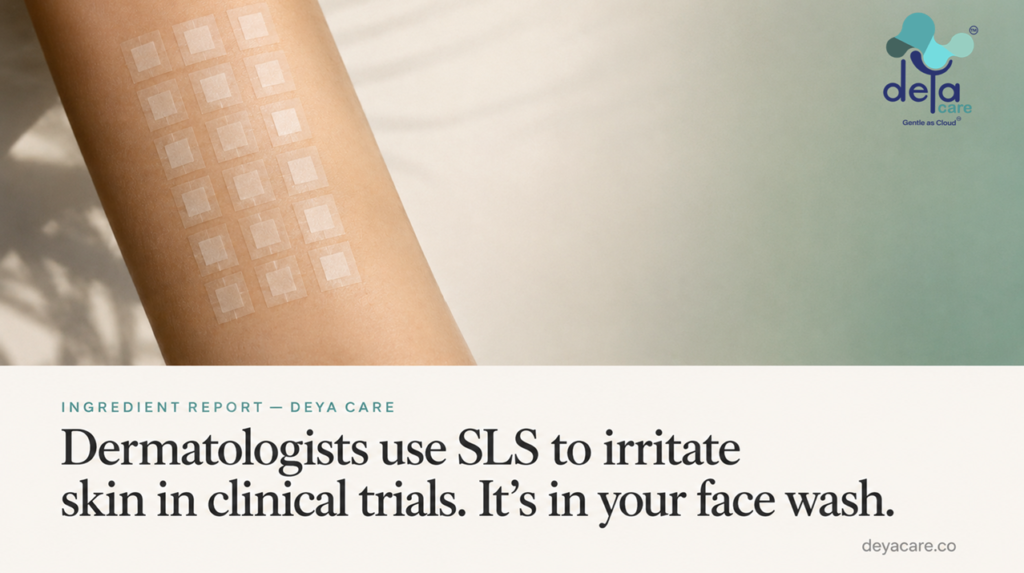
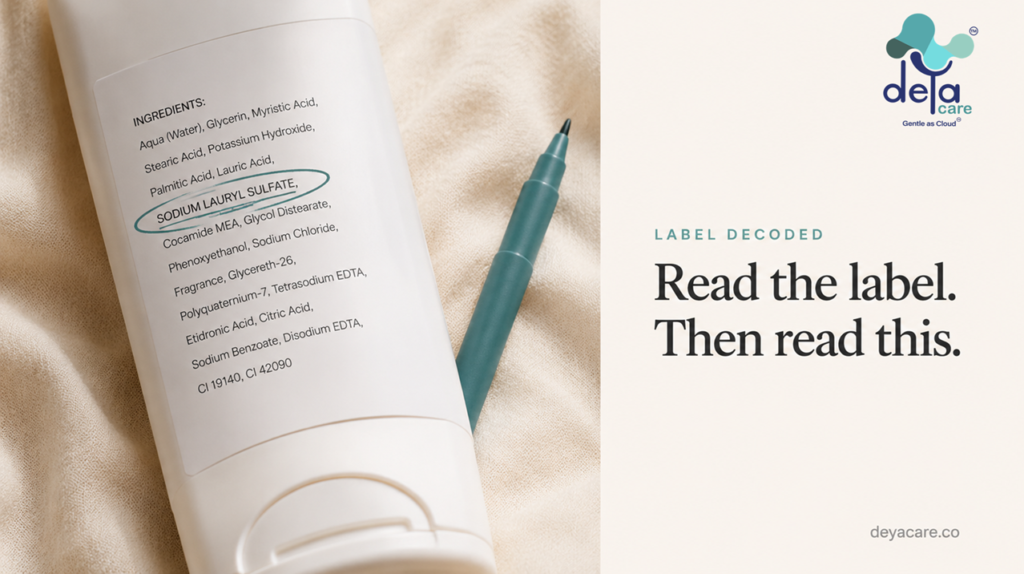
Dermatologists use SLS to irritate skin on purpose. It’s in your face wash.
When a research lab needs to provoke a reliable skin reaction — to test whether a new moisturizer actually repairs the barrier, for instance — they don’t reach for some exotic chemical. They reach for Sodium Lauryl Sulfate. SLS is the gold-standard irritant in dermatological patch testing. It’s that dependable.
It’s also in most drugstore cleansers in India, including ones marketed as “deep cleansing,” “anti-acne,” or “for oily skin.”
That contradiction is worth sitting with — particularly if you’re dealing with breakouts, pigmentation, or skin that feels tight five minutes after washing. This is why Deya Care’s cleansers — Blemish Be Gone and Luma Cleanse — are formulated without it, and what we use instead.
First, what SLS isn’t
Let’s clear the air. SLS is not carcinogenic. The viral wellness posts claiming it causes cancer are wrong, and the FDA, EU’s SCCS, and the Cosmetic Ingredient Review panel have all confirmed this.
So the question isn’t is SLS dangerous? The question is: is it the right surfactant for your face? For most Indian skin types — and especially anyone managing acne or pigmentation — the answer is no.
What SLS actually does to your skin
SLS is an anionic surfactant, which is a technical way of saying it’s a very aggressive cleanser. It binds tightly to oils and proteins and lifts them off, which is why it foams so impressively and feels like it’s “really working.” That squeaky-clean feeling? That’s not cleanliness — that’s your skin barrier being stripped.
Here’s what’s happening underneath, in plain terms:
- Your skin barrier gets dissolved. SLS strips the lipids (ceramides, cholesterol, fatty acids) that hold your skin cells together. Think of it as washing out the mortar from a brick wall.
- Water escapes faster. With the barrier compromised, moisture evaporates from deeper layers. The clinical term is transepidermal water loss. The feeling is tightness, flaking, and that “my skin can’t drink enough” sensation.
- Your skin’s pH goes alkaline. Healthy facial skin sits around pH 4.7–5.5 — slightly acidic, which keeps bacteria in check. SLS shifts this alkaline for hours, disrupting your microbiome.
- Low-grade inflammation sets in. Even when you don’t see irritation, sustained SLS use drives subclinical inflammation. This matters enormously because inflammation is the upstream driver of both acne breakouts and post-inflammatory hyperpigmentation — the dark marks that linger long after a pimple is gone.
The kicker: this is happening before your serum, your sunscreen, or your retinol ever touches your face.
Why this matters more in India
A few realities make Indian skin especially poorly suited to SLS-based cleansers:
- Melanin-rich skin pigments aggressively in response to inflammation. Any irritation — even invisible — can trigger PIH and worsen melasma. Your skin doesn’t just react; it remembers.
- Hard water in most Indian cities amplifies surfactant residue, leaving more stripping on skin than the formulator intended.
- Pollution + UV + humidity swings already keep urban skin in a low-grade inflammatory state. SLS adds to that load.
- We layer a lot. Sunscreen, makeup, actives, oils. A compromised barrier in the morning means everything you put on top performs worse.
Who should specifically switch away from SLS
- Acne-prone skin — barrier disruption makes acne worse and slows healing
- Pigmentation, melasma, or post-acne dark marks — inflammation activates melanocytes
- Sensitive, atopic, or rosacea-prone skin — SLS is a documented trigger
- Anyone using actives — retinoids, AHAs, BHAs, vitamin C, benzoyl peroxide work on stressed skin
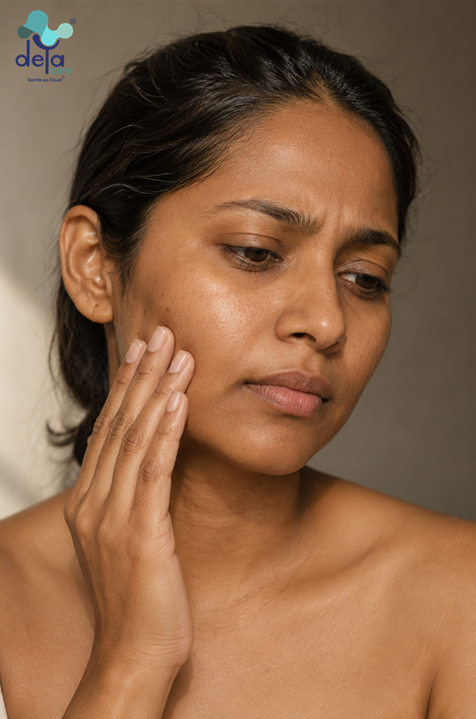
- Anyone whose skin feels tight after washing — that’s the signal
What good surfactants look like (without the jargon)
You don’t need SLS to get a satisfying lather. Modern gentle surfactants — derived from amino acids, coconut, or sugar — clean just as effectively without dissolving your barrier. Look for these on ingredient lists:
- Sodium Cocoyl Isethionate — creamy lather, very mild
- Sodium Methyl Cocoyl Taurate — gentle, great for acne-prone skin
- Cocamidopropyl Betaine — soft foam, calming
- Sodium Cocoyl Glutamate — amino-acid-based, naturally pH-balanced
- Decyl / Coco Glucoside — sugar-derived, ultra-mild
If your current cleanser doesn’t have any of these — and lists Sodium Lauryl Sulfate near the top of the ingredient list — your barrier is probably paying for that foam.
The Deya Care alternative
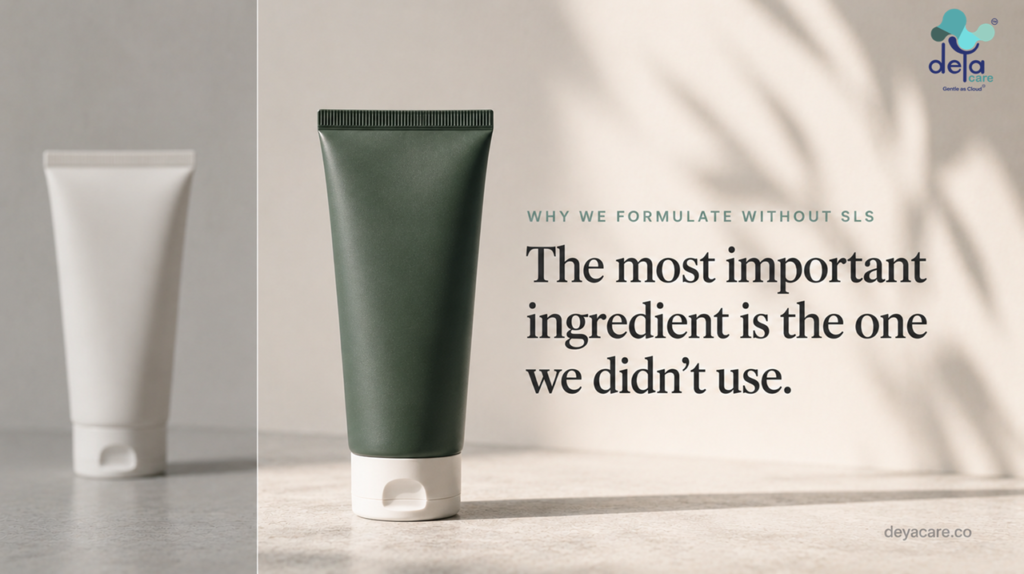
We built our cleansers on a simple principle: your face wash shouldn’t undo the work your actives are trying to do.
A salicylic acid serum applied to a stripped, alkaline, inflamed face is not the same product as the same serum applied to a calm, intact barrier. The skin you cleanse onto determines what your routine can actually achieve.
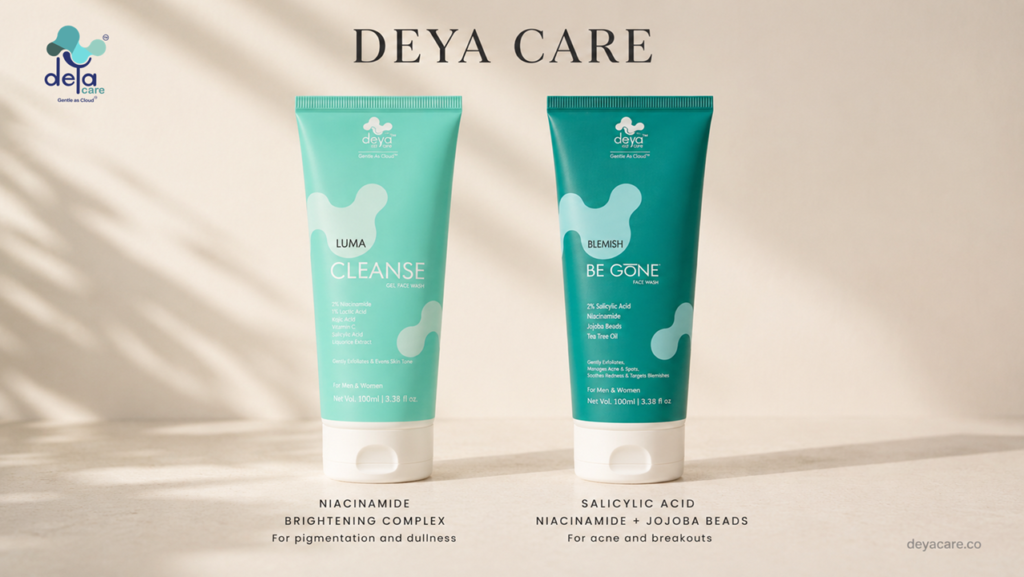
🌿 Blemish Be Gone — Salicylic Acid + Niacinamide Cleanser
For oily, congested, acne-prone skin.
- Salicylic acid dissolves into the pore lining to clear keratin plugs and stop comedones forming
- Niacinamide regulates sebum, calms inflammation, and fades post-acne marks by interfering with melanin transfer
- Built on amino-acid surfactants at skin-compatible pH — clears congestion without the rebound oiliness most acne washes cause
✨ Luma Cleanse — Brightening Niacinamide Cleanser
For dull, uneven, pigmentation-prone skin.
- Niacinamide at a level that visibly evens tone over weeks of consistent use
- Brightening complex that supports gentle surface renewal — no scrubs, no harsh acids
- Sulfate-free, acidic-pH base that keeps the barrier intact, so brightness builds instead of fighting daily irritation
If you’ve been using actives and not seeing results, this is often the missing piece. The barrier has to be intact for the serum to do its job.

A few honest questions we get asked
Will a sulfate-free wash actually foam? Yes. You’ll get a softer, creamier lather — not the dense industrial foam of SLS, but enough that your brain still registers “this is cleansing.” Most people don’t miss the difference after a week.
Will it work in hard water? Yes. Indian water conditions slightly reduce foam volume across all surfactants, but cleansing performance holds up. We test for this.
Can I layer actives like retinol on top? That’s largely the point. A non-stripping cleanser is what makes actives tolerable. Most “my retinol is irritating me” problems trace back to a compromised barrier from the cleanser, not the retinol.
Is the salicylic acid in Blemish Be Gone strong enough if it’s in a gentle cleanser? Yes. Salicylic acid efficacy comes from pH and formulation, not from harsh surfactants. A well-formulated mild base often delivers actives better than a stripping one, because the skin isn’t inflamed at the point of contact.
The bottom line
SLS isn’t a poison. It’s a clinical-grade irritant — a fact dermatologists have used in their patch tests for decades. For acne-prone, pigmented, or sensitive Indian skin, swapping it out is one of the simplest, highest-leverage things you can do for your routine.
Great skincare often begins not with what you add — but with what you stop using.
Try Blemish Be Goneif you’re managing breakouts, or Luma Cleanseif you’re working on brightness and even tone.
Both available at www.deyacare.co (and on Amazon, Flipkart, and Myntra).